 English
 Arabic

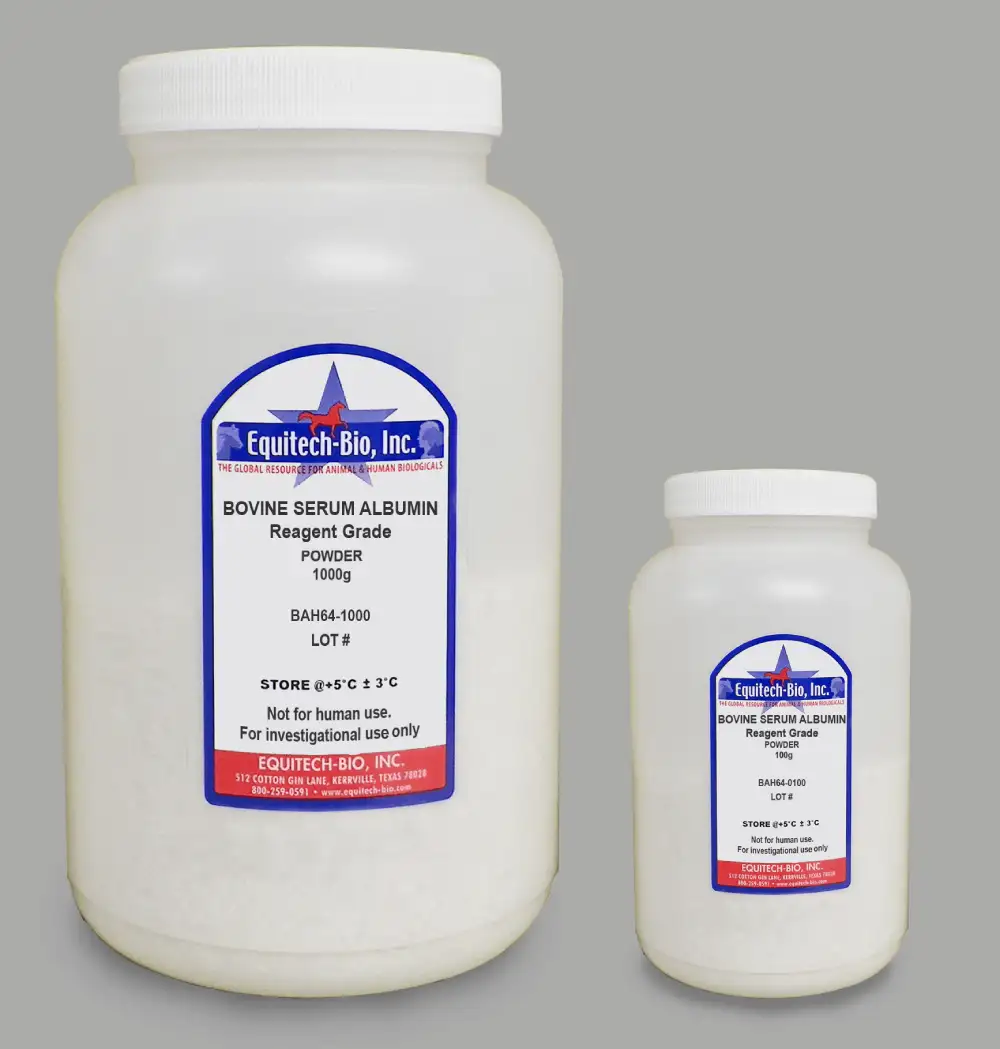
BSA Powder vs BSA Solution: Which Format Is Right for Your Lab?
Ask two labs which BSA format they prefer, and you’ll likely get two confident, opposite answers. Both are probably right for their workflow. Powder and solution are the same protein, but they solve different problems: one gives you full control over concentration and buffer at the cost of a prep step; the other saves that step but locks you into whatever the manufacturer shipped.
The format itself isn’t really the decision, though. Grade, purity, and formulation matter more, and those depend on what the assay actually demands. Here’s how to think through both.
BSA Powder
Powder is bovine serum albumin in its lyophilized, dried form, usually supplied in bulk. You reconstitute it yourself at whatever concentration and in whatever buffer your protocol calls for.
That flexibility is the main advantage. One container of powder can yield several different working solutions, which is useful if your lab runs varied protocols rather than the same assay repeatedly.
Grades range from standard and reagent to diagnostic, protease-free, and fatty acid-free, and which one you need has nothing to do with powder versus liquid; it’s entirely about what the downstream assay requires.
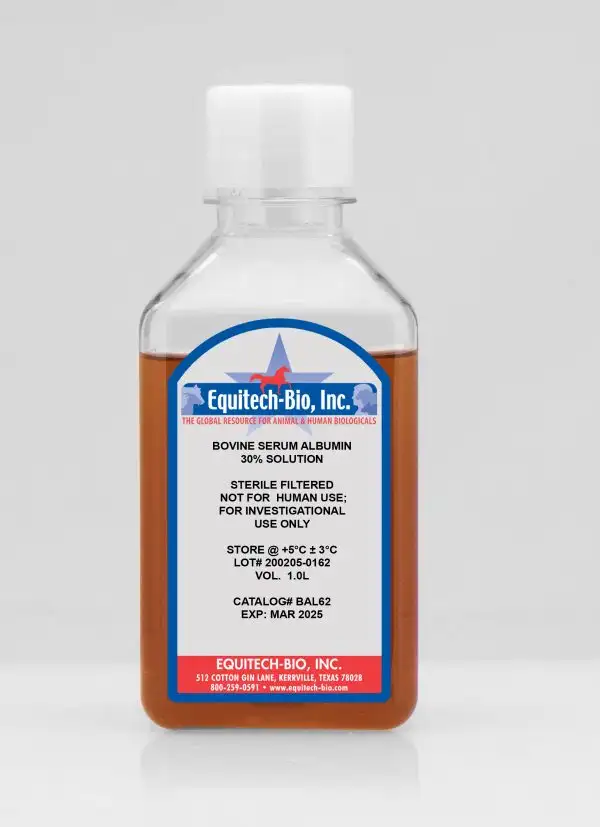
Liquid BSA Solution
The solution skips the reconstitution step. It arrives already dissolved at a defined concentration in a specified buffer, ready to be pipetted directly into an assay.
That convenience isn’t uniform across every product on the shelf, though. Some solutions are sterile-filtered, some carry preservatives, and some are concentrated for further dilution. Check the technical data sheet before assuming you know what you’re getting.
The solution is most valuable in high-volume, repetitive work, where removing a single variable from the prep process improves the assay with each run. For a sense of what a rigorously characterized solution looks like, NIST maintains a certified 7% BSA solution, Standard Reference Material 927g, made from USDA-inspected cattle blood and used to calibrate total protein testing across clinical labs nationwide.
Key Differences Between BSA Powder and Solution
Laid side by side, the trade-offs are straightforward:
| Factor | BSA Powder | BSA Solution |
| Preparation | Requires reconstitution before use | Ready to use out of the container |
| Customization | High; adjust concentration and buffer | Limited to supplied concentration |
| Storage | Stable at room temperature or refrigerated, format-dependent | Often requires refrigeration; check label |
| Consistency | Depends on operator technique | Consistent from lot to lot as supplied |
| Handling | Requires weighing and mixing equipment | Minimal handling required |
| Cost | Lower per gram at scale | Higher per unit, less prep labor. |
| Waste | Only reconstitute what is needed. | Unused volume may expire before use. |
No format is best for every application. The key factors are formulation needs, pack size, throughput, and how reagents are actually stored in your lab day-to-day.
Preparation and Consistency
Every extra step is a chance for two people to do the same thing slightly differently, and reconstituting powder adds extra steps: weighing, dissolving, and sometimes filtering. The solution sidesteps that almost entirely, since every aliquot from a lot carries the same concentration regardless of who’s at the bench. In assays sensitive to small preparation differences, that consistency is worth something real.
Storage and Shelf Life
Powder tends to hold up over time, whether at room temperature or refrigerated, depending on grade and packaging, though the certificate of analysis should always confirm which applies to your lot. Liquid doesn’t age as gracefully. It typically needs refrigeration, has a shorter working life once opened, and can degrade with repeated freeze-thaw cycles, which is why aliquoting matters more than people think.
That degradation risk isn’t just anecdotal. Writing in the Journal of Pharmaceutical Sciences, researchers from the University of Connecticut noted that “freezing is one of the preferred routes to stabilize biotherapeutic solutions,” while cautioning that poorly handled freeze-thaw cycles can still erode protein quality over time.
Cost and Waste
Powder is cheaper per gram, mostly because you’re not paying to ship water and packaging along with the protein, and that gap widens at scale. The solution costs more per unit but buys back labor and prep time. There’s a waste tradeoff too: powder lets you reconstitute exactly what you need, while an unused solution can sit in the fridge until it expires.
Factors to Consider When Choosing a BSA Format
The label on the container matters less than what your assay actually specifies. A few questions cut through most of the decision.
Assay Requirements
Does your protocol call for an exact concentration, buffer, or additive profile? That’s powder territory. Can it tolerate a standard, pre-formulated solution instead? Check the validated matrix before assuming either format is a drop-in swap, since switching formats without revalidating is how assays quietly stop working.
Laboratory Throughput
If your lab runs a rotating cast of different experiments, powder’s flexibility pays for itself; one container covers a dozen unrelated protocols. If you’re running the same assay over and over, solution consistency and a lighter prep load tend to win out.
Product Quality Specifications
Fatty acid content, protease content, endotoxin level, and IgG content matter regardless of format, so check them against your assay’s validated requirements rather than assuming a grade based on habit. Cell culture and receptor-binding work generally require fatty acid-free material; kinase and cell-based assays usually require protease-free, low-endotoxin grades.
In regulated or high-throughput environments, a pre-formulated solution’s built-in consistency can also make audits and cross-operator reproducibility easier to defend.
How to Prepare and Store Each BSA Format
Protocols vary by formulation, so treat the certificate of analysis or technical data sheet as the final word, not this guide. What holds across both formats is simpler: clean technique, clear labeling, and careful aliquoting keep either one from degrading before its time.
Reconstituting BSA Powder
Dissolve it gradually at the temperature specified in your documentation, mixing gently rather than vigorously to avoid foaming or denaturing the protein. Work in small batches when precision matters. Filter afterward if sterility is required, and label every aliquot with concentration, lot number, and date before storing it per the certificate of analysis.
Handling Liquid BSA
Keep it refrigerated unless told otherwise, and resist the urge to freeze and thaw it more than necessary. As soon as a container is opened, split it into smaller working portions. It’s a small habit that does a lot to reduce the risk of contamination and extend shelf life.
How to Choose BSA Powder or Solution for Your Lab
If customization and bulk savings matter more to you than convenience, and your lab has the discipline to prepare it consistently, go with powder. If convenience and standardized prep matter more than the cost per gram of shaving, go with the solution.
Either way, confirm these details before you place your order:
- Grade (standard, reagent, diagnostic, protease-free, or fatty acid-free)
- Final concentration and buffer compatibility
- Storage conditions and expected shelf life
- Certificate of analysis and lot documentation
- Total cost, including prep labor and expected waste
If your work calls for a human-derived protein matrix rather than a bovine one, human serum albumin is available in comparable grades. And when the decision genuinely could go either way, a conversation with a technical supplier usually resolves it faster than running both formats side by side to find out.
Choosing With Confidence
Format is the smaller part of this decision. What actually determines whether BSA performs reliably in your assay is grade, purity, and documented consistency, not whether it started as a powder or a liquid. Both formats earn their place; the question is which one fits how your lab actually runs.
When specifications matter more than convenience, work with a supplier that documents every lot completely. Contact Equitech-Bio to review current grade options and request a reserve sample for your next application.
BSA Powder vs Solution FAQs
How Long Does Reconstituted BSA Last?
There's no universal timeframe. Shelf life depends on formulation, concentration, and storage conditions, so check the expected duration on the certificate of analysis.
Does Liquid BSA Need Refrigeration?
That depends on the specific product. Check the label or technical data sheet for the exact temperature range before storing any solution.
Which BSA Format Is Better for Western Blotting?
Neither is inherently better. Validated concentration and formulation compatibility matter more than whether the BSA was supplied as a powder or a liquid.
 English
 Arabic